

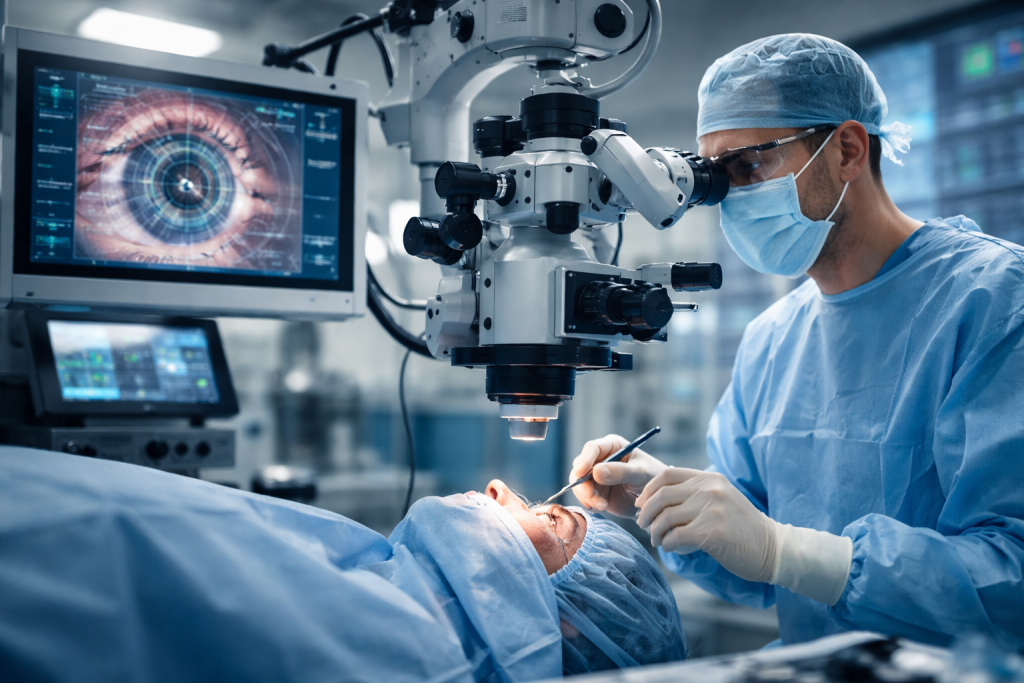
Could eye surgery become safer and faster than ever before? Today, most surgeons leverage the latest technology to map the microscopic details of your eyes. Traditional surgeries rely mainly on manual instruments and expertise. However, modern technologies like AI and femtosecond lasers have transformed the diagnostic processes. These innovations improve surgical accuracy and reduce recovery times.
Qualified ophthalmologists conduct the surgeries as data-driven procedures. It allows patients to have a better outcome from the surgery. Let us discuss the latest tech improvements for eye surgeries today!
AI Technology for Eye Diagnosis
Artificial Intelligence has transformed the preoperative diagnosis for people with eye issues. By detecting subtle ocular pathologies, AI improves your surgical safety.
AI-driven cameras and advanced software analyze high-resolution scans for your eye. That is why it is easy to detect structural issues in your cornea or macula.
Moreover, AI helps surgeons measure axial length and corneal thickness for intraocular lens calculation during surgery.
Robotic Technologies for Eye Surgeries
Robotic-assisted technology enables surgeons to maintain precision during surgery. Complex eye operations can be performed with sub-micrometer precision. The robotic technology also eliminates the risk of human error in the surgical process. What’s more, it provides a range of advantages to patients:
- Minimally invasive process, leading to reduced complications and faster recovery
- Higher accuracy while implanting the lens
For instance, the LASIK eye surgery in the Bay area involves using the robotic systems to provide better results. The latest technological advancement leads to sharper vision and safer treatments.
Bladeless Laser Surgery for the Eyes
A bladeless LASIK surgery process involves using two types of lasers:
- Femtosecond Laser – For creating an ultra-thin flap in the cornea
- Excimer Laser – For reshaping the cornea to ensure correction
The surgeon then positions the flap back to its place, but they use no blades in this process. This FDA-approved process provides a range of advantages:
- No fear of blades
- Precise cutting
- More customized treatment
- Faster recovery
- Better quality, ultra-thin flap
- Tissue saving
SMILE or Relex SMILE is another variant of Femto-Second Bladeless LASIK and is effective in correcting vision. The laser technology cuts a part of the corneal tissue, pulled out through a corneal flap for vision correction.
Digital Surgical Guidance and Augmented Reality
Digital overlays and AR are effective technologies to assist surgeons during an operation. They project important data, which is essential for surgery. Moreover, these technologies enable surgeons to view guidance systems in real time. The major advantages of AR and digital guidance are:
- Better visualization of your eye structure
- Improved surgical accuracy
- Training opportunities for novice surgeons
AR-assisted surgery is a step toward making your eye operation smarter and safer. Besides, AR is used for better 3D visualization of your retinal structures during the delicate surgical process.
Conclusion
Innovative technologies have revolutionized eye surgery in different ways. AI-driven diagnostics allow surgeons to identify eye disorders accurately. What’s more, robotic-assisted procedures have made performance safer for patients. In the future ophthalmologic field, these technologies promise clearer vision and better patient experiences!